Saving lives during Venezuela’s twin earthquake catastrophe

Joining one of the largest-scale relief efforts in history, PDC embedded analysts and its DisasterAWARE technology ecosystem into mission operations to help save lives during response to the event...

Photograph: World Food Programme

By Chani Goering

07/09/2026

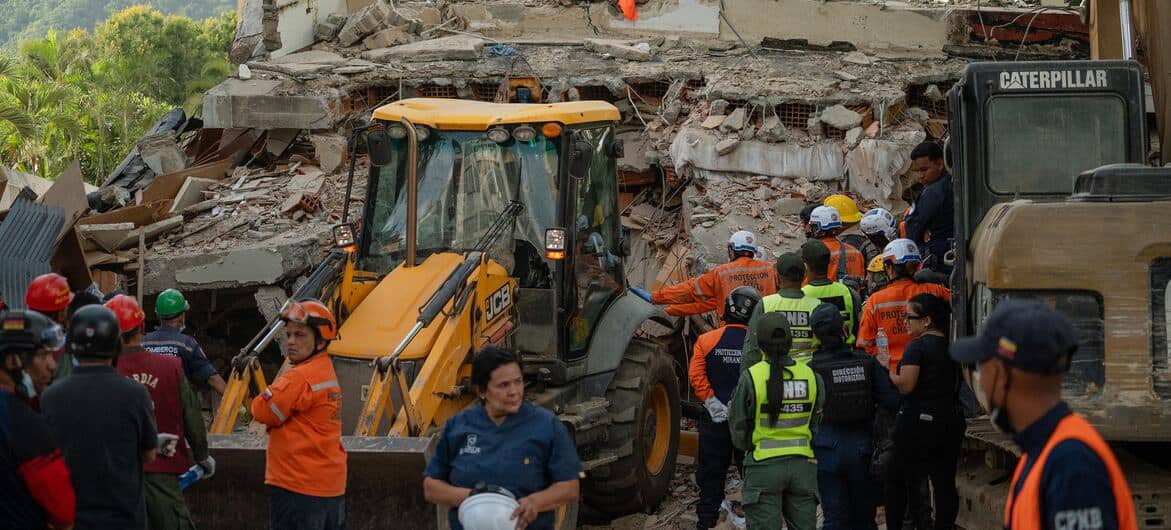
Tens of thousands of buildings, along with critical infrastructure, were damaged or destroyed due to widespread soft-story construction prone to pancake collapse. 

Photograph: Associated Press

How interoperability and rapid analysis helped save lives

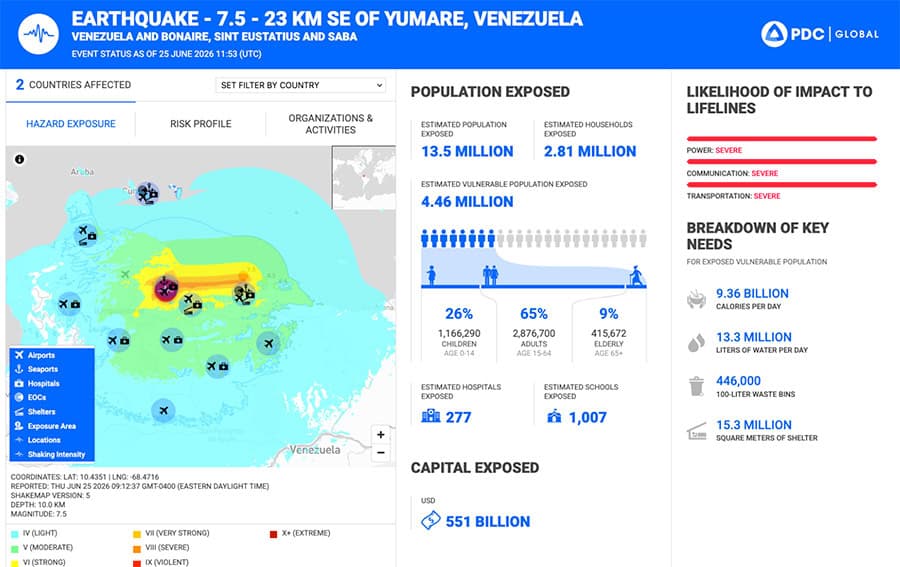
On June 24, 2026, two mega quakes (M7.2 and M7.5) struck west of the capital city of Caracas, Venezuela, roughly 39 seconds apart, devastating La Guaira and the states of Yaracuy and Carabobo. The sequence generated hundreds of aftershocks and triggered the largest international urban search and rescue (USAR) mobilization in the region’s history. PDC’s initial estimates placed 13.5 million people within the shaking zone, including a vulnerable population of 4.46 million.

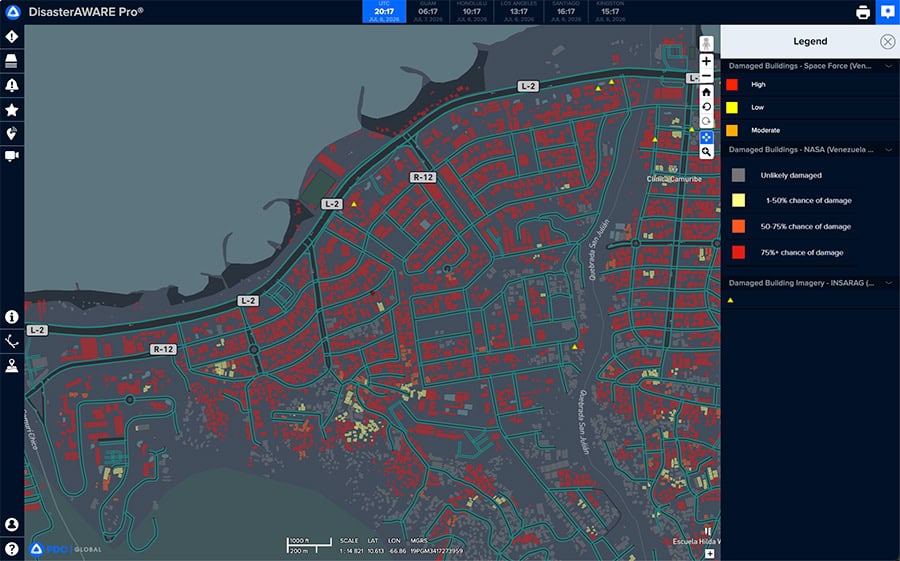
Joining one of the largest-scale relief efforts in history, PDC embedded analysts and its DisasterAWARE technology ecosystem into mission operations engaged in the response. . From rapid impact assessments and USAR activity tracking, to 96-hour needs forecasting and real-time integration of building damage data, PDC was the authoritative data provider that guided major U.S. relief operations. Shortly after impact, its information streams and analytical insights generated initial estimates of impacts to critical systems to aid planning and prioritization of resources for responders facing widespread building collapse and disrupted power, water, and communications lifelines.

DisasterAWARE: The authoritative data source for the global response

The response began within minutes. Six minutes after the earthquakes, DisasterAWARE had issued early warnings for the quakes and tsunami hazard, along with estimated impacts and needs. By eleven minutes, PDC Smart Alerts had reached more than 3.5 million DisasterAWARE users worldwide. And within 30 minutes, direct operational support to responders had been activated, with continuous updates flowing thereafter.

Timeline of PDC's early onset insights and expert analysis
6 min
DisasterAWARE issues early warning (EQs/tsunami), estimated impacts, needs
11 min
PDC Smart Alerts go to 3.5M+ DisasterAWARE users worldwide
<30 min
Joint Operations Center (JOC) activation, with continuous updates

Venezuela Twin Earthquake Event Synopsis

PDC estimates 13.5 million people were inside the shaking zone, many of whom live in informal hillside settlements prone to destruction from quakes and rain-triggered landslides.

Photograph: PDC

A PDC Event Brief was generated within minutes, providing the earliest understanding of impacts to populations, infrastructure, and critical community lifelines such as power, communication, and transportation.

Event Stats

(As of July 7, 2026)

MagnitudesM7.2 + M7.5
Aftershocks400+
Death toll3,342
Injured16,740
Displaced12,841 registered
Missing40,000+
DamagesUS$37B
USAR67 teams / 2,500+ pers
Source: Pacific Disaster Center (PDC), Government of Venezuela, UNOCHA sitreps, others. Counts expected to rise.

Key Response Challenges

1
Scale of destruction. Tens of thousands of buildings along with critical infrastructure were damaged or destroyed due to widespread soft-story construction prone to pancake collapse. PDC estimates 13.5 million people were inside the shaking zone, many of whom live in informal hillside settlements prone to destruction from quakes and rain-triggered landslides.
2
A massive, multinational coordinated response. Sixty-seven USAR teams—more than 2,500 personnel and 188 dogs from dozens of nations—converged alongside U.N. agencies, nongovernmental organizations (NGOs), and military elements, each arriving with different systems, data, and reporting chains.
3
Search and rescue access and logistics. Infrastructure damage across seven states, including the partial collapse of a key airport and landslides along the coastal corridor, complicated logistics in the critical first 72 hours. USAR teams had to convoy in from hundreds of miles away over damaged roads and severed bridges.

The 72-hour race to reach survivors

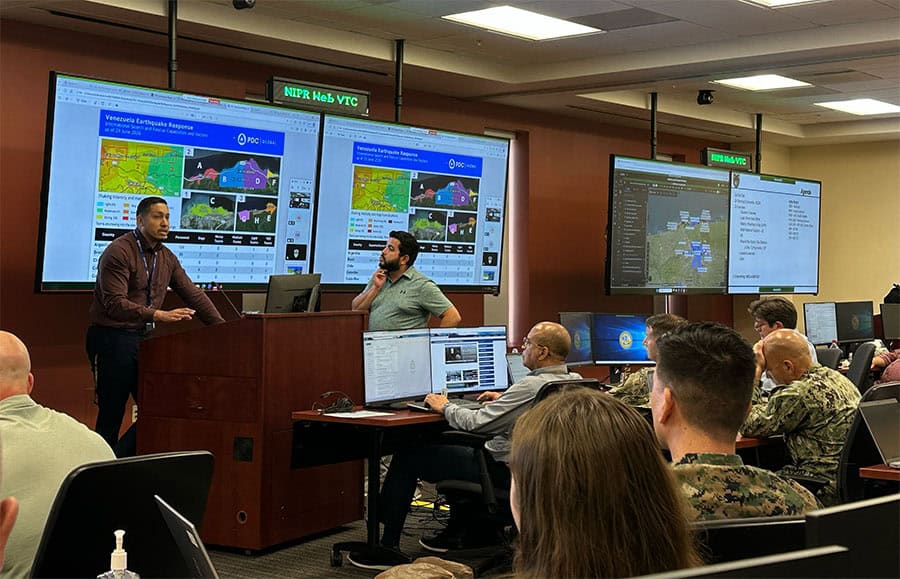
PDC briefs on USAR locations and team activities;

Photograph: PDC

While lives hung in the balance, partners from every sector of the response relied on the same live foundation of PDC data through the DisasterAWARE ecosystem. PDC analysts collaborated with civil and military partners responding to the crisis from within the Combined Humanitarian Coordination Cell to provide early estimates of impacts to affected populations, the built environment, airports, seaports, hospitals, and schools, as well as tsunami and sea-level fluctuation warnings. Its critical infrastructure exposure assessments helped rank the hardest-hit areas while ground reports were still hours away. These insights informed operational briefings, planning cells, and resource decisions.

With sixty-seven USAR teams from dozens of nations, coordination challenges could not be solved through individual field reports alone. PDC’s live tracking of team locations, capabilities, and sector assignments gave a holistic view of which sectors had teams working, which did not, and where arriving units could do the most good alongside regional and international partners already on the ground. PDC also helped provide a comprehensive civil-military operating picture, integrating information from UNOCHA, WFP, IFRC, PAHO, and others for continuous situational awareness.

Above: Sample analytical products developed by PDC to aid international response and recovery efforts.

Photographs: PDC

The same picture shaped how assistance was physically moved. PDC assessments of airports, seaports, and road corridors identified which access points could bear the load, letting logistics staff set routes and priorities for USAR teams and relief cargo entering the affected region. More than 37 mission-critical datasets—shaking intensity, satellite-derived damage, infrastructure status, aid distribution sites, and more—were added to DisasterAWARE during the response, keeping the picture current as conditions changed.

As rescue gave way to recovery, PDC’s 96-hour needs outlooks, powered by the Center’s AI for Humanity technology, gave each planning cycle a head start—flagging emerging demands across health system restoration, debris management, transitional sheltering, water and sanitation, and humanitarian coordination before they became shortfalls.

The mission is not finished. PDC platforms remain the operational backbone for tracking evolving impacts, coordinating relief, and supporting evidence-based decisions as Venezuela’s recovery continues.

One mission. Many partners. Safer world.

PDC capabilities informed the J79 Civil-Military Operations Division and the international humanitarian relief effort, enabling information sharing and quick integration of new data from multiple sources. During the response, 352 new DisasterAWARE user accounts were created—153 U.S. Government accounts and 199 accounts for humanitarian actors. Organizations PDC supported, included: 

  • U.S. Government (SOUTHCOM, U.S. State Department)
  • United Nations Office for the Coordination of Humanitarian Affairs (UNOCHA)
  • World Food Programme (WFP)
  • Pan American Health Organization (PAHO/WHO)
  • International Federation of Red Cross and Red Crescent Societies (IFRC)
  • Others


Why preparedness makes a difference

One of the biggest challenges in responding to a disaster of this scale is information-sharing across organizational lines. As a neutral, science-based organization trusted globally across agencies and sectors, PDC has worked hard to close this gap by providing a common operational picture during times of disaster that strengthens collaboration, coordination, and outcomes. The DisasterAWARE ecosystem was not introduced in the middle of a crisis—it was already part of the international operating environment that bridges communities. It has been exercised through continuous engagements and is embedded in the workflows of the organizations that need it.

This type of long-term investment meant that when the massive earthquake doublet rocked Venezuela, there was no ramp-up period. Impact assessments reached decision-makers within hours, and 338 new users across the response community were onboarded onto platforms their organizations already trusted.

The mission is not finished. PDC platforms remain the operational backbone for tracking evolving impacts, coordinating relief, and supporting evidence-based decisions as Venezuela’s recovery continues

Major Outcomes

Throughout crisis operations, PDC provided authoritative data, rapid analytics, and forward-looking decision support that enabled senior leaders, planners, logisticians, interagency partners, and multinational responders to operate from a more integrated common operational picture.


Rapid impact assessment: Complete integration of the Philippine Institute of Volcanology and Seismology (PHIVOLCS) data into PhilAWARE provided immediate early warning and visualization of impacts for decision-makers in the Philippines.
System interoperability: The DisasterAWARE ecosystem bridged partner systems, ensuring a common foundation of operational data for senior-level decision-making..
A shared operational picture for USAR: Team locations, capabilities, sector assignments, and deployment status for 67 international teams supported coverage analysis and gap identification.
Logistics planning: Assessments of airports, seaports, and critical infrastructure informed route evaluation, access prioritization, and the flow of USAR teams and humanitarian assistance into theater.
Anticipated operational needs: AI-powered 96-hour forward assessments guided decisions across health, debris, sheltering, WASH, logistics, and humanitarian coordination through the recovery transition.
Information sharing: Humanitarian partners and the J79 Civil-Military Operations Division leveraged PDC platforms to integrate information that could be shared across mission operations.
Get quarterly updates about our innovations and projects!
(Email Registration) Quarterly Email Updates
First
Last

ABOUT PDC

Pacific Disaster Center (PDC) is a leading scientific innovator of global risk reduction science and technology. As a University of Hawai’i applied science and research center, our work intersects with a variety of government, community, academic, and scientific organizations at home and around the world to build resilience to natural and man-made hazards—enhancing the capacity to quickly and accurately anticipate and prepare for new and emerging threats. Our innovations in multi-hazard early warning systems, predictive analytics, data science, and machine learning provide decision-makers with the powerful tools and insights they need to navigate today’s complex and interconnected risk landscape.

Related News