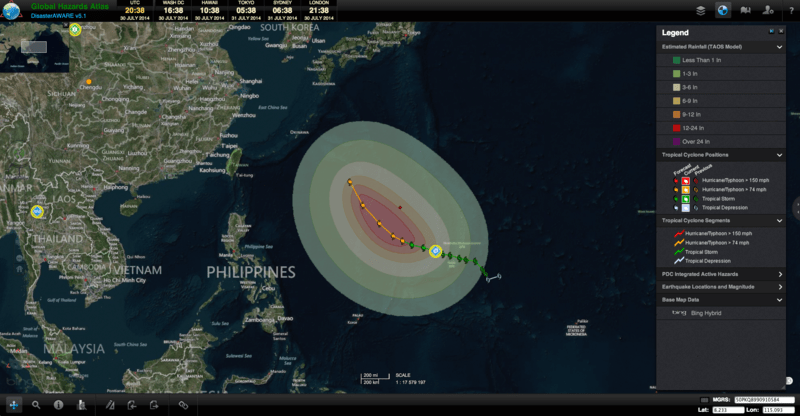
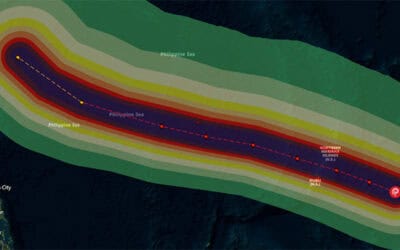
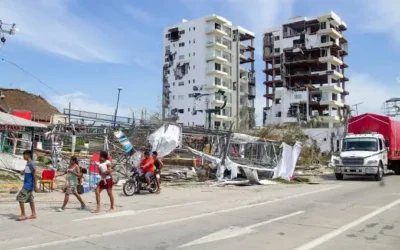
Tropical Cyclone Halong (11W) has passed between Rota and Guam in the Mariana Islands. According to a Stars and Stripes blog, heavy rainfall caused flooding in low-lying areas of Guam, and strong winds downed trees and power lines in several villages resulting in power outages.
Rota was relatively unscathed by TC Halong. Rota’s Mayor Melchor A. Mendiola stated that no flooding was reported in residential areas because neighborhoods are located at a higher elevation than the coastline, in a release by Guam’s Pacific Daily News.
In preparation for the cyclone, the JTWC generated a tropical storm warning for Guam, Tinian and Saipan, and typhoon warning for Rota. Additionally, the National Weather Service (NWS) issued flash flood warnings for Guam and Rota. However, all tropical storm and typhoon warnings have been expired.
TC Halong remains active in the northwestern Pacific Ocean and is tracking west-northwestward. JTWC expects TC Halong to intensify to typhoon status by August 1, as it moves northwestward in the western Pacific.
For more information on Tropical Cyclone Halong:
• Visit the Joint Typhoon Warning Center or National Weather Service for the latest updates,
• View the Guam Homeland Security/Office of Civil Defense page,
• Take a look at information from NASA and
• Visit Guam’s Pacific Daily News.
ABOUT PDC
Pacific Disaster Center (PDC) is a leading scientific innovator of global risk reduction science and technology. As a University of Hawai’i applied science and research center, our work intersects with a variety of government, community, academic, and scientific organizations at home and around the world to build resilience to natural and man-made hazards—enhancing the capacity to quickly and accurately anticipate and prepare for new and emerging threats. Our innovations in multi-hazard early warning systems, predictive analytics, data science, and machine learning provide decision-makers with the powerful tools and insights they need to navigate today’s complex and interconnected risk landscape.