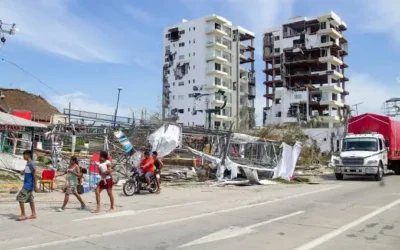
Advanced technology pushes back against catastrophic losses during wrath of Irma
Tools developed by the Pacific Disaster Center (PDC) are helping officials from Florida and Georgia, FEMA, and responders throughout the U.S. and Caribbean make better decisions faster, resulting in fewer deaths and catastrophic losses. As Irma dissipates into a tropical storm, dropping heavy rain throughout the Florida panhandle into parts of Georgia, the still uncertain […]
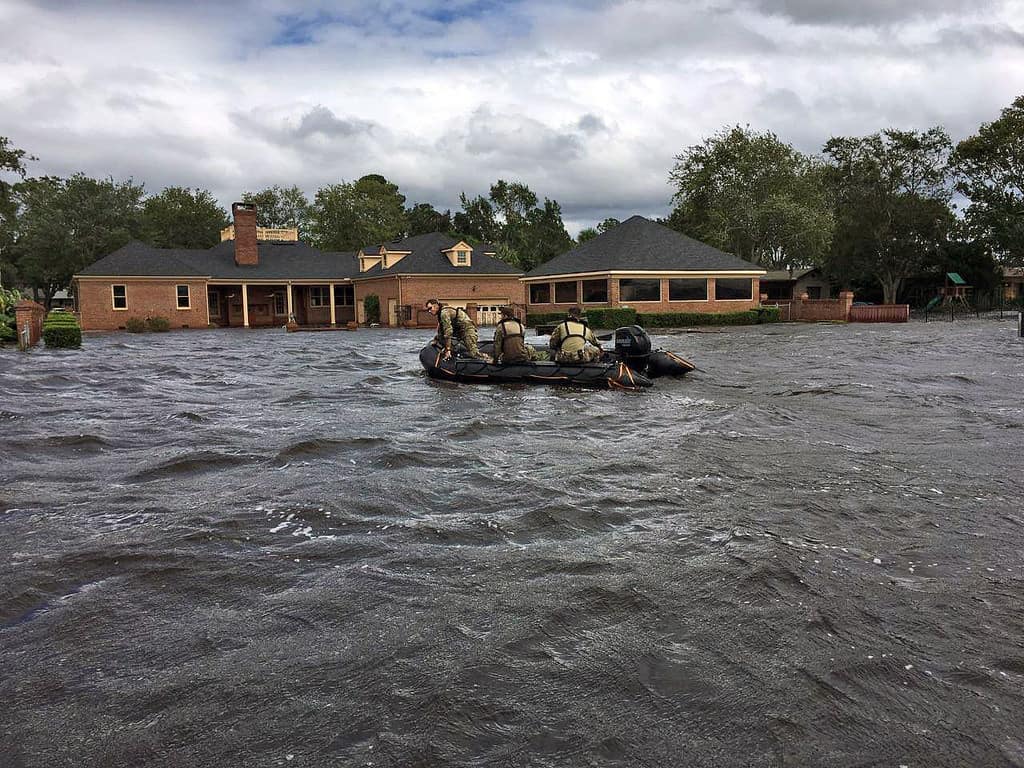
Tools developed by the Pacific Disaster Center (PDC) are helping officials from Florida and Georgia, FEMA, and responders throughout the U.S. and Caribbean make better decisions faster, resulting in fewer deaths and catastrophic losses. As Irma dissipates into a tropical storm, dropping heavy rain throughout the Florida panhandle into parts of Georgia, the still uncertain total death toll is expected to remain staggeringly low compared to much weaker hurricanes in the past. While every life lost to Irma and other disasters remains a tragedy, reduced losses is a remarkable accomplishment considering today’s large population exposed to Irma’s Category 4 winds, storm surge, and flooding rainfall.
According to Bernd (Bear) McConnell, PDC’s Senior Advisor and former Director of the U.S. Office of Foreign Disaster Assistance (OFDA), today’s state and local officials rely heavily on fast, accurate, and quantifiable information to take appropriate actions that effectively protect communities in harm’s way. He said, “What you see in Florida—low injuries and casualties, fewer building and infrastructure damages compared to those of the past—is a noteworthy example of how real-time decision tools like DisasterAWARE have empowered officials to make the right decisions or issue the tough call for mandatory evacuation.”
Turning to a single, super-technology that packs the power of NASA’s satellite imagery, NOAA’s scientific forecast weather data, and PDC’s robust data holdings including hazard exposure data, population and economic impact data, and numerous infrastructure data, DisasterAWARE is being used at all levels of government around the world to meet the fast-paced nature of disaster management.
“Our all-hazards platform, DisasterAWARE, is the same real-time technology that was used to monitor Hurricanes Harvey and Irma, the recent earthquake and tsunami in Mexico, and currently Hurricane Jose in the Atlantic, Typhoon Halim near Taiwan, and wildfires throughout the State of California,” said PDC’s Executive Director, Ray Shirkhodai.
By bringing all the all the information together from top sources into a single, common operating platform, Pacific Disaster Center (PDC)—A University of Hawaiʻi managed Applied Science Center—has developed a scientific tool like no other. PDC is helping decision makers recognize the power of DisasterAWARE for not only monitoring and response, but for planning and recovery operations. “DisasterAWARE is being used to identify vulnerable populations, simulate hazard events and impacts to help disaster managers develop and exercise plans, as well as inform disaster risk reduction policies to protect communities from future hazards,” said Dr. Erin Hughey, Director of Disaster Services at PDC.
ABOUT PDC
Pacific Disaster Center (PDC) is a leading scientific innovator of global risk reduction science and technology. As a University of Hawai’i applied science and research center, our work intersects with a variety of government, community, academic, and scientific organizations at home and around the world to build resilience to natural and man-made hazards—enhancing the capacity to quickly and accurately anticipate and prepare for new and emerging threats. Our innovations in multi-hazard early warning systems, predictive analytics, data science, and machine learning provide decision-makers with the powerful tools and insights they need to navigate today’s complex and interconnected risk landscape.
Pacific Disaster Center (PDC), in partnership with the U.S. Pacific Command (US PACOM), and twenty-nine other nations, international organizations, and interagency partners, supported the humanitarian assistance and disaster response (HADR) component of Rim of the Pacific (RIMPAC) 2026…
As Guam and the Commonwealth of the Northern Mariana Islands (CNMI) braced for impacts from a second super typhoon in less than three months, the Pacific Disaster Center (PDC) joined regional preparedness coordination and relief efforts…
Joining one of the largest-scale relief efforts in history, PDC embedded analysts and its DisasterAWARE technology ecosystem into mission operations to help save lives during response to the event…
The June 8 Mindanao earthquake demonstrated how years of investment in PhilAWARE, training, and operational integration of critical life-saving data enabled immediate situational awareness and coordinated decision-making across the Philippines national disaster response system…
With more than 6.5 million fans from over 100 countries converging on cities across the United States, Mexico, and Canada for the 2026 FIFA World Cup, the public health stakes are significant. The team is leveraging DisasterAWARE for timely, integrated situational awareness…
NOAA forecasters are sounding the alarm: super El Niño is coming and it could mean record impacts during hurricane season—especially across the Eastern and Central Pacific basins…