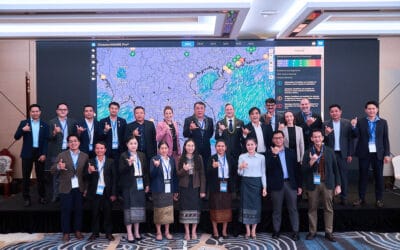
Hawai‘i’s Pacific Disaster Center receives prestigious United Nations Sasakawa Award for Disaster Risk Reduction
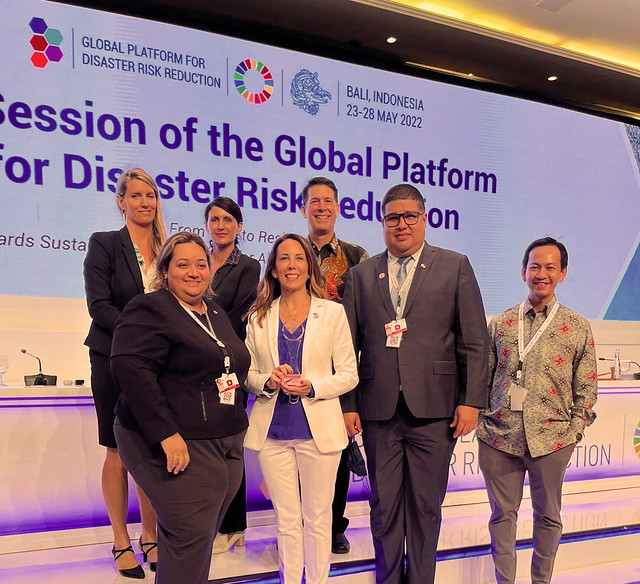
Bali, Indonesia / Kihei, HI: The University of Hawaiʻi’s Pacific Disaster Center (PDC) was named laureate of the prestigious United Nations Sasakawa Award for Disaster Risk Reduction during the Global Platform for Disaster Risk Reduction (GPDRR) in Bali, Indonesia on May 25, 2022. “This award is given every three years to individuals or institutions that […]
Bali, Indonesia / Kihei, HI: The University of Hawaiʻi’s Pacific Disaster Center (PDC) was named laureate of the prestigious United Nations Sasakawa Award for Disaster Risk Reduction during the Global Platform for Disaster Risk Reduction (GPDRR) in Bali, Indonesia on May 25, 2022. “This award is given every three years to individuals or institutions that have made substantive impact in reducing disaster risk,” said Mami Mizutori, special representative of the secretary-general for disaster risk reduction, during the opening ceremony. The UN Sasakawa Award for 2022 focuses on “Building resilience through a multi-hazard approach.”
“Pacific Disaster Center is honored and humbled by the recognition we’ve received from the United Nations and our partners for our efforts to help create safer, more disaster-resilient communities,” said PDC Executive Director Ray Shirkhodai following the announcement. “We share this award with all like-minded, hard-working humanitarians with a passion for helping the vulnerable among us and reducing disaster risk to make life better for all citizens.”
“We proudly support PDC’s recognition under this year’s Sasakawa Award. For nearly two decades, ASEAN (Association of Southeast Asian Nations) nations and the PDC have worked together to advance early-warning and disaster risk reduction science throughout Southeast Asia. PDC is a vital partner who has helped the AHA Centre (ASEAN Coordinating Centre for Humanitarian Assistance on disaster management) ensure the best science and technology are appropriately and effectively utilized to prepare for and respond to disasters throughout the region,” said AHA Centre Assistant Director for Disaster Monitoring and Analysis Lawrence Anthony Dimailig.
Dimailig said PDC’s DisasterAWARE platform and risk information serve as the foundation of the AHA Centre’s multi-hazard Disaster Monitoring and Response System, which is integral to the operational coordination of nearly every major disaster event in the region.
“PDC’s innovations and agility have produced some of the best science, data, and technology in the field of disaster management—supporting not only Hawaiʻi and the Pacific, but the global humanitarian community in some of the most disaster-prone regions of the world,” said University of Hawaiʻi’s President Dr. David Lassner. PDC is an applied research center of UH.
PDC’s Director of Global Operations Dr. Erin Hughey—a key architect of the Center’s National Disaster Preparedness Baseline Assessment program—said that even as a large part of the world continues to lack effective multi-hazard early warning systems, a country’s understanding of multi-hazard risk at the national and local level is equally important. She said the center’s baseline assessment puts risk information into action and operationalizes the goals of the United Nations Sendai Framework for Disaster Risk Reduction.
“The baseline assessment goes well beyond a printed report to be read once by policymakers.
Instead, we are extending a host of new subnational data and risk assessment results to the entire global humanitarian community for active use in response, preparation, and recovery from disasters,” said Hughey during her award acceptance speech for PDC.
Hughey said assessment data and risk information also feed robust modeling and analytics provided inside PDC’s DisasterAWARE tool—helping to anticipate hazard impacts to populations and infrastructure as well as humanitarian needs with much greater accuracy.
“This year, Panama achieved a significant and historic milestone when the country’s newly-established Comprehensive Disaster Risk Management Cabinet met for the first time to advance national policies, strategic plans, and programs that reduce disaster risks.” said Adherbal de la Rosa, Panamá’s director of the Technical Office of Comprehensive Disaster Risk Management. “The benchmark assessment, which PDC conducted in close partnership with a broad community of stakeholders in the international, national, local and NGO communities over the course of the past two years, has effected measurable change within the Ministry of the Interior and SINAPROC (Panama’s civil defense system).”
Carl Smith, permanent secretary of the Ministry of Disaster Preparedness, Management, and Reconstruction in The Bahamas, said recent PDC’s assessment findings provide evidence to support policies and programs that increase resilience and “institute risk-informed decision making that encourages sustainable development, multi-agency cooperation, and helps align capacity development with priority needs.”
Lassner said PDC’s evidence-based approach to disaster management has helped shape the field of disaster risk reduction for more than 25 years and will continue to do so.
“With the formidable challenges posed by the rise in extreme weather events globally, and the complexity of managing multiple hazards such as during the height and aftermath of the COVID-19 pandemic, governments must place even greater focus on adaptation and resilience,” Lassner said. “The partnership networks of PDC and its arsenal of tools are certain to be an invaluable asset in helping the global community make this shift.”
Pacific Disaster Center (PDC Global) is a leading scientific innovator in disaster risk reduction science and technology. As a University of Hawai’i applied science and research center, our work intersects with government, community, academic, and scientific organizations at home and around the world to build resilience to natural and man-made hazards. We enable communities to confront disasters more effectively by enhancing the capacity to rapidly anticipate and prepare for new and emerging threats using our AI-powered multi-hazard early warning technology, DisasterAWARE, predictive analytics, data science, and machine learning. For more than 30 years, PDC innovations have equipped decision-makers with the powerful tools and insights they need to navigate today’s complex and interconnected risk landscape.
PDC received prestigious recognition from the United Nations for its international impact in 2022, being granted the once-in-a-lifetime U.N. Sasakawa Award for Disaster Risk Reduction.
Lao PDR initiative to reduce risk and build resilience gains momentum with Disaster Resilience Worskhop and National Disaster Preparedness Baseline Assessment mid-term review and exchange.
Pacific Disaster Center (PDC), in partnership with the U.S. Pacific Command (US PACOM), and twenty-nine other nations, international organizations, and interagency partners, supported the humanitarian assistance and disaster response (HADR) component of Rim of the Pacific (RIMPAC) 2026…
As Guam and the Commonwealth of the Northern Mariana Islands (CNMI) braced for impacts from a second super typhoon in less than three months, the Pacific Disaster Center (PDC) joined regional preparedness coordination and relief efforts…
Joining one of the largest-scale relief efforts in history, PDC embedded analysts and its DisasterAWARE technology ecosystem into mission operations to help save lives during response to the event…
On June 17, 2026, Lao PDR solidified its commitment to building disaster resilience, joining 33 countries worldwide to partner with the Pacific Disaster Center (PDC) on a National Disaster Preparedness Baseline Assessment (NDPBA)….
The June 8 Mindanao earthquake demonstrated how years of investment in PhilAWARE, training, and operational integration of critical life-saving data enabled immediate situational awareness and coordinated decision-making across the Philippines national disaster response system…