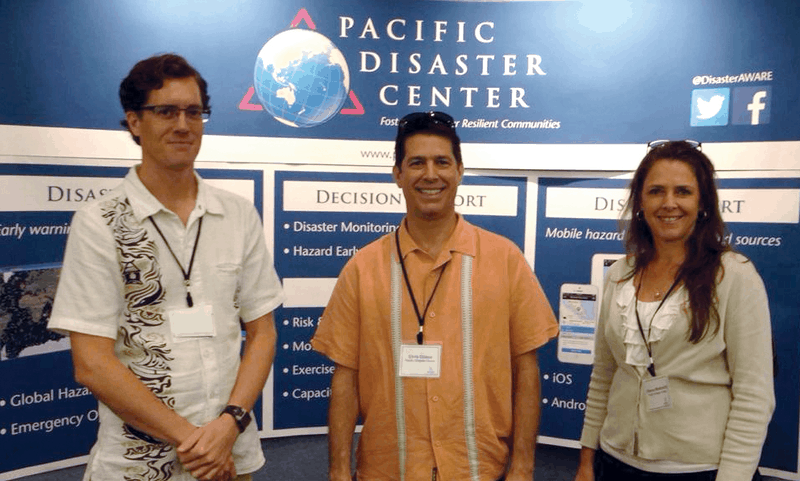
Marking its twelfth meeting in as many years, the Pacific Risk Management Ohana (PRiMO) gathered in Honolulu, March 10–14. This year’s annual conference, themed Building Communities of Practice for Resilience, was co-presented by PRiMO and Partnership for Pacific Resilience (PPR), a newly created nonprofit organization. The event drew disaster managers, public institutions, community stakeholders, and private-sector partners from across the Pacific to discuss and coordinate opportunities to enhance disaster resilience in the Pacific region. The event offered a number of working groups (Hui), panel and discussion sessions, and workshops for participants, providing an effective platform for innovative technology demonstrations and research sharing, as well as opportunities for professional development and training.
Serving as the Chair of the Navigator’s Council, or board of directors, for the past two years, Pacific Disaster Center’s (PDC) Deputy Executive Director Chris Chiesa presided over this year’s event, the largest PRiMO meeting to-date with nearly 300 participants from Hawaii, the U.S. mainland, Pacific island states, New Zealand, and Vietnam.
A number of notable speakers and participants attended, including President Anote Tong of Kiribati, who spoke of the severe crisis his nation faces from rising sea-levels; and Hawaii Governor Neil Abercrombie, who led a “Hawaii Resilience Forum.” Other noteworthy participants included U.S. Ambassador (ret.) David C. Litt, who currently holds the position of Executive Director of the Center for Stabilization and Economic Reconstruction; as well as Dr. Nguyen Huu Ninh, Dr. Penehuro Lefale, and Dr. Eddie Bernard, who shared in the 2007 Nobel Prize awarded to members of the UN Intergovernmental Panel on Climate Change (IPCC).
PDC staff members played significant roles in planning and execution of the event. PDC-led activities included break-out sessions on data collection and mapping efforts in the Pacific, a working group session on the Hawaii Hazards Awareness and Resilience Program (HHARP) at the community level, and a planning meeting of the Information Access and Geospatial Technology Hui.
Additional information about the 2014 PRiMO meeting:
• Visit the PRiMO website,
• Access the 2014 conference program here,
• View their Facebook page, a
• Read about the 2013 PRiMO meeting.
ABOUT PDC
Pacific Disaster Center (PDC) is a leading scientific innovator of global risk reduction science and technology. As a University of Hawai’i applied science and research center, our work intersects with a variety of government, community, academic, and scientific organizations at home and around the world to build resilience to natural and man-made hazards—enhancing the capacity to quickly and accurately anticipate and prepare for new and emerging threats. Our innovations in multi-hazard early warning systems, predictive analytics, data science, and machine learning provide decision-makers with the powerful tools and insights they need to navigate today’s complex and interconnected risk landscape.