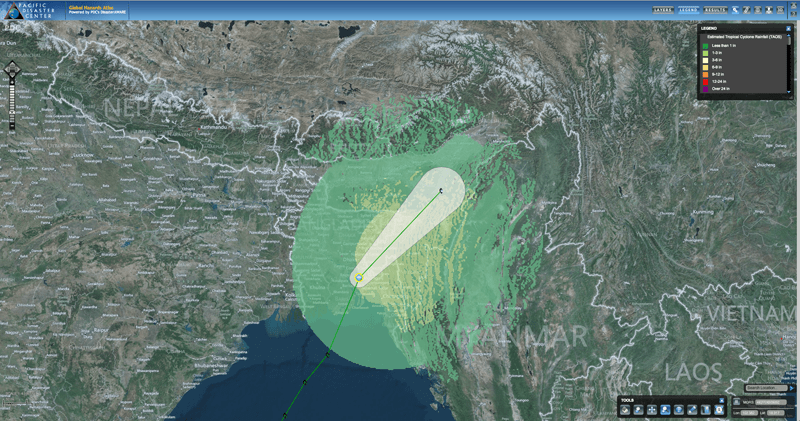
In Bay of Bengal, part of the Northern Indian Ocean, Tropical Cyclone (TC) Mahasen made landfall after tracking past eastern India towards Bangladesh and Myanmar. The cyclone made landfall in the delta area northwest of Chittagong, Bangladesh. Along with impacts inland as the storm dissipates, it continues to delivered heavy rain, wind, and storm surge to coastal residents and ocean-goers in the Bay.
Over the next 24 hours, it is predicted that the storm will continue to lose strength and dissipate. However, high numbers of people in the region are vulnerable to extreme flooding due to dense urban areas that exist within low-lying coastal areas.
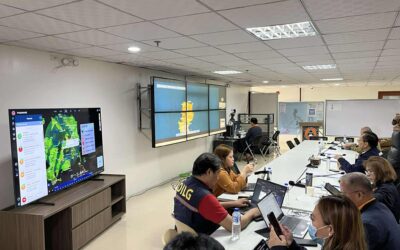
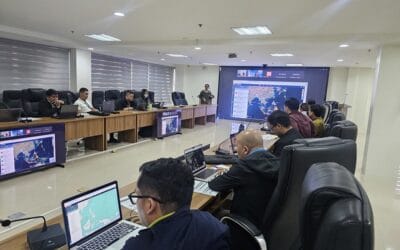
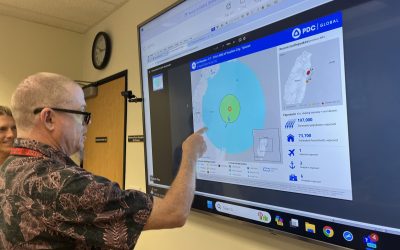
Pacific Disaster Center (PDC) has been actively monitoring the development and movements of TC Mahasen, providing daily reports for the public on the Weather Wall. Also, the Global Hazards Atlas provides direct access to updates on the storm’s location and intensity. Users can view forecasts on its movements and information about critical infrastructure, population, and other at risk resources.
In addition to publicly available resources, PDC continues to work with the international humanitarian assistance community to provide critical information and support to disaster management professionals involved with preparation and relief efforts. Since TC Mahasen’s early detection last week, PDC has been producing briefings and distributing daily situational awareness products for various agencies such as United Nations Office for the Coordination of Humanitarian Affairs (OCHA), United States (U.S.) Pentagon, and US Pacific Command (PACOM), as well as for the government of Bangladesh.
As the storm moves further inland, PDC will continue to monitor the situation closely and will work with international partners to provide support to their operations.
ABOUT PDC
Pacific Disaster Center (PDC) is a leading scientific innovator of global risk reduction science and technology. As a University of Hawai’i applied science and research center, our work intersects with a variety of government, community, academic, and scientific organizations at home and around the world to build resilience to natural and man-made hazards—enhancing the capacity to quickly and accurately anticipate and prepare for new and emerging threats. Our innovations in multi-hazard early warning systems, predictive analytics, data science, and machine learning provide decision-makers with the powerful tools and insights they need to navigate today’s complex and interconnected risk landscape.