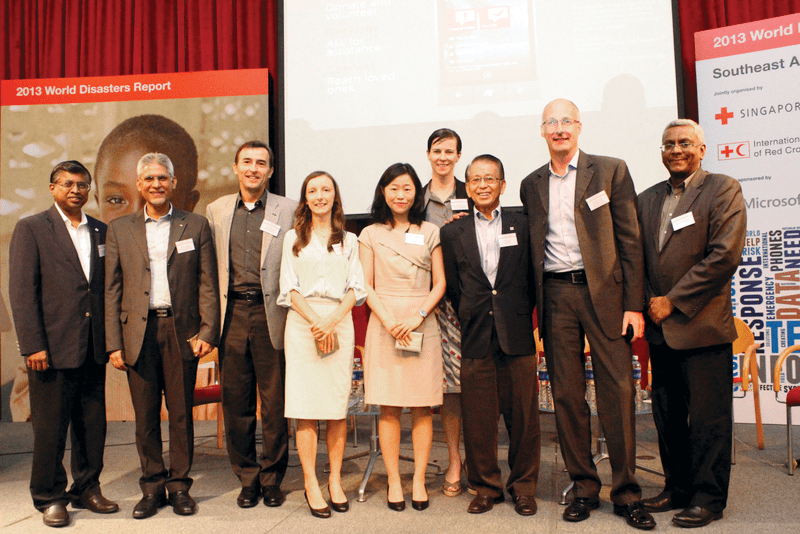
The Singapore Red Cross Society (SRC) and the International Federation of Red Cross and Red Crescent Societies (IFRC) organized the Southeast Asia launch for the “2013 World Disasters Report (WDR),” an annual IFRC research publication that provides an opportunity to reflect on specific themes and expert opinions related to disasters and disaster management. Sponsored by Microsoft Corporation, the launch event was held on October 17 at the YWCA Fort Canning Lodge in Singapore. This year’s WDR focused on technology and the future of humanitarian action, and examined the potential of technology to improve humanitarian operations and increase the disaster resilience of communities.
Pacific Disaster Center (PDC) Southeast Asia Program Advisor Victoria Leat was invited to support the event as a panelist. Leat provided an overview of PDC programs and activities in the region, specifically focusing on those that enhance information flow and system interoperability, and promote data sharing between and among disaster risk reduction (DRR) stakeholders. Leat joined a diverse panel of speakers including Microsoft’s Asia Time Zone Lead for Worldwide Public Safety and National Security Arthur Thomas “A.T.” Ball, IFRC Asia Pacific Director Jagan Chapagain, Harvard Humanitarian Initiative (HHI) associate faculty member Dr. Maya Arii, and the Head of the UN Office for the Coordination of Humanitarian Affairs (OCHA) Regional Office for Asia and the Pacific (ROAP) Oliver Lacey-Hall. Channel NewsAsia International Desk Editor Augustine Anthuvan chaired the event.
In the audience, there were more than 100 invited members of the press, including representatives of the Wall Street Journal. The journalists engaged in a lively discussion with the panelists, providing Leat the opportunity to share details of PDC’s many experiences and activities in Southeast Asia.
For more information on this event:
• Visit the Southeast Asia Launch event site, and
• Download the 2013 WDR here.
ABOUT PDC
Pacific Disaster Center (PDC Global) is a leading scientific innovator in disaster risk reduction science and technology. As a University of Hawai’i applied science and research center, our work intersects with government, community, academic, and scientific organizations at home and around the world to build resilience to natural and man-made hazards. We enable communities to confront disasters more effectively by enhancing the capacity to rapidly anticipate and prepare for new and emerging threats using our AI-powered multi-hazard early warning technology, DisasterAWARE, predictive analytics, data science, and machine learning. For more than 30 years, PDC innovations have equipped decision-makers with the powerful tools and insights they need to navigate today’s complex and interconnected risk landscape.
PDC received prestigious recognition from the United Nations for its international impact in 2022, being granted the once-in-a-lifetime U.N. Sasakawa Award for Disaster Risk Reduction.