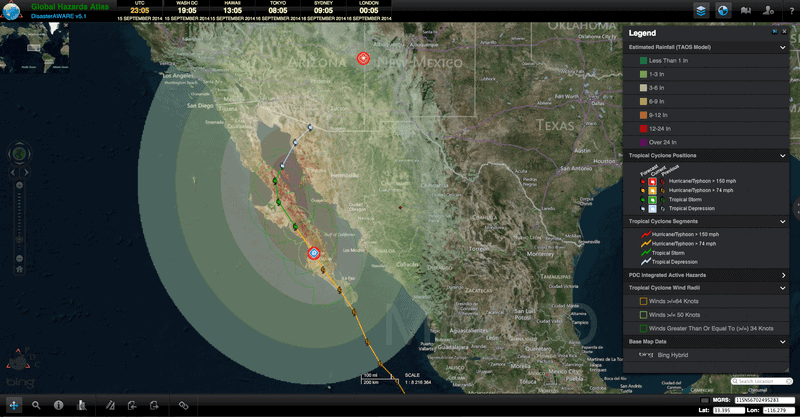
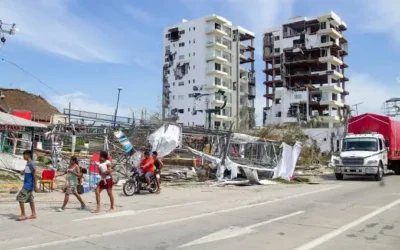
On Sunday, September 14 (local time), the Mexican resort city of Cabo San Lucas bore the powerful strength of Hurricane Odile, as it made landfall. Due to the heavy rainfall and fierce winds that knocked down trees, and cut off power, locals and tourists were forced to evacuate and seek emergency shelter. The Associated Press reported that Luis Felipe Puente, the national coordinator for Mexico’s civil protection agency, said that Mexican authorities evacuated residents in coastal areas and 164 shelters had been opened for as many as 30,000 people in Baja California Sur.
The current (Monday afternoon) National Hurricane Center (NHC) advisory indicates that Odile is currently weakening, but continues to pose serious threats due to heavy rainfall and flooding. The center of Odile is expected continue to move over the Baja California Peninsula through Tuesday, September 16, and move over the northern Gulf of California, also called the Sea of Cortez, on Wednesday, September 17.
Along its path, Odile will continue to bring powerful winds, create dangerous storm surge that is expected to cause significant coastal flooding, dump intense rainfall with the potential to result in life-threatening flash floods and mudslides, and generate treacherous surf and rip-current conditions.
For more information on Hurricane Odile:
• Visit the National Hurricane Center for the latest advisory and forecasts,
• Take a look at information from NASA, and
• View information and updates on Weather Underground (WU).
ABOUT PDC
Pacific Disaster Center (PDC) is a leading scientific innovator of global risk reduction science and technology. As a University of Hawai’i applied science and research center, our work intersects with a variety of government, community, academic, and scientific organizations at home and around the world to build resilience to natural and man-made hazards—enhancing the capacity to quickly and accurately anticipate and prepare for new and emerging threats. Our innovations in multi-hazard early warning systems, predictive analytics, data science, and machine learning provide decision-makers with the powerful tools and insights they need to navigate today’s complex and interconnected risk landscape.