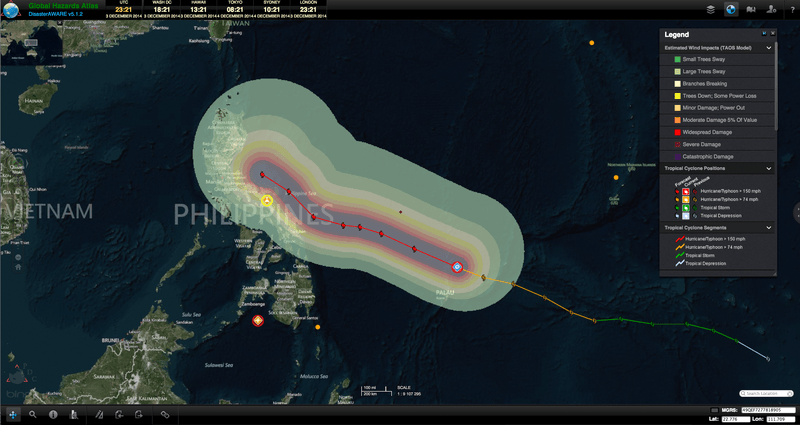
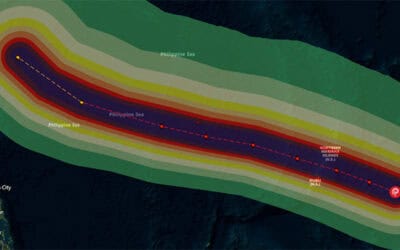
Barreling through the Federated States of Micronesia, Tropical Cyclone Hagupit rapidly strengthened into a Super Typhoon in the northwestern Pacific Ocean on Thursday morning, December 4 (local time). Passing dangerously close between the state of Yap in the Federated States of Micronesia and the Republic of Palau, Hagupit is producing very rough seas with wave heights reaching 42 feet, according to the latest warning from the Joint Typhoon Warning Center (JTWC). Hagupit is forecast to continue strengthening over the next few days, before beginning to weaken.
The latest public advisory from the Guam National Weather Service (NWS) reports the cancellation of the typhoon warning for Yap and the Ngulu Atoll in Yap State. However, a tropical storm warning and typhoon watch remain in effect for Kayangel and a tropical storm warning also remains in effect for Koror both in the Republic of Palau. Hagupit is generating heavy rainfall, powerful winds, dangerous seas and storm surge, and the potential for local flooding in low-lying and in poor-drainage areas.
While no public storm warning signal has been issued for the Philippines yet, the weather bulletin issued by the Philippine Atmospheric, Geophysical and Astronomical Services Administration (PAGASA) expects Hagupit to enter the Philippine Area of Responsibility on Thursday. At that point, the cyclone will be locally named Ruby.
In preparation for the effects of Hagupit, the Philippine National Disaster Risk Reduction and Management Council (NDRRMC) convened the Pre-Disaster Risk Assessment core group as a preparedness measure, while local authorities with humanitarian partners came together to review contingency plans, as reported in the most recent Flash Update from UN Office for the Coordination of Humanitarian Affairs (OCHA).
In November 2013, the Eastern Visayas region of the Philippines was devastated, and hardest hit by Super Typhoon Haiyan.
For more information on Tropical Cyclone Hagupit:
• Visit the Joint Typhoon Warning Center for the latest updates,
• Follow advisories from the Guam National Weather Service,
• Loot at updated PAGASA weather advisories, and
• Visit the NDRRMC for weather bulletins.
ABOUT PDC
Pacific Disaster Center (PDC) is a leading scientific innovator of global risk reduction science and technology. As a University of Hawai’i applied science and research center, our work intersects with a variety of government, community, academic, and scientific organizations at home and around the world to build resilience to natural and man-made hazards—enhancing the capacity to quickly and accurately anticipate and prepare for new and emerging threats. Our innovations in multi-hazard early warning systems, predictive analytics, data science, and machine learning provide decision-makers with the powerful tools and insights they need to navigate today’s complex and interconnected risk landscape.