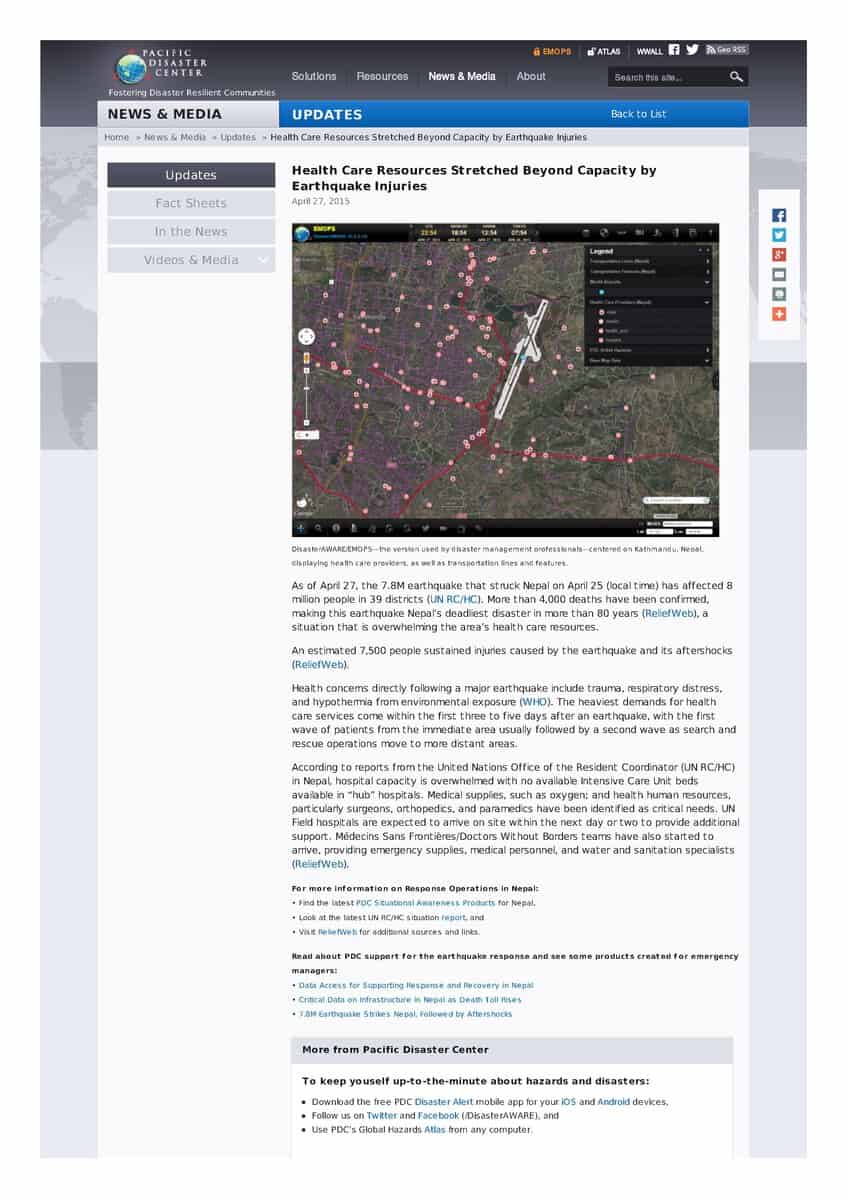
DisasterAWARE/EMOPS—the version used by disaster management professionals—centered on Kathmandu, Nepal, displaying health care providers, as well as transportation lines and features.
As of April 27, the 7.8M earthquake that struck Nepal on April 25 (local time) has affected 8 million people in 39 districts (UN RC/HC). More than 4,000 deaths have been confirmed, making this earthquake Nepal’s deadliest disaster in more than 80 years (ReliefWeb), a situation that is overwhelming the area’s health care resources.
An estimated 7,500 people sustained injuries caused by the earthquake and its aftershocks (ReliefWeb).
Health concerns directly following a major earthquake include trauma, respiratory distress, and hypothermia from environmental exposure (WHO). The heaviest demands for health care services come within the first three to five days after an earthquake, with the first wave of patients from the immediate area usually followed by a second wave as search and rescue operations move to more distant areas.
According to reports from the United Nations Office of the Resident Coordinator (UN RC/HC) in Nepal, hospital capacity is overwhelmed with no available Intensive Care Unit beds available in “hub” hospitals. Medical supplies, such as oxygen; and health human resources, particularly surgeons, orthopedics, and paramedics have been identified as critical needs. UN Field hospitals are expected to arrive on site within the next day or two to provide additional support. Médecins Sans Frontières/Doctors Without Borders teams have also started to arrive, providing emergency supplies, medical personnel, and water and sanitation specialists (ReliefWeb).
For more information on Response Operations in Nepal:
• Find the latest PDC Situational Awareness Products for Nepal,
• Look at the latest UN RC/HC situation report, and
• Visit ReliefWeb for additional sources and links.
Read about PDC support for the earthquake response and see some products created for emergency managers:
• Data Access for Supporting Response and Recovery in Nepal
• Critical Data on Infrastructure in Nepal as Death Toll Rises
• 7.8M Earthquake Strikes Nepal, Followed by Aftershocks
ABOUT PDC
Pacific Disaster Center (PDC) is a leading scientific innovator of global risk reduction science and technology. As a University of Hawai’i applied science and research center, our work intersects with a variety of government, community, academic, and scientific organizations at home and around the world to build resilience to natural and man-made hazards—enhancing the capacity to quickly and accurately anticipate and prepare for new and emerging threats. Our innovations in multi-hazard early warning systems, predictive analytics, data science, and machine learning provide decision-makers with the powerful tools and insights they need to navigate today’s complex and interconnected risk landscape.