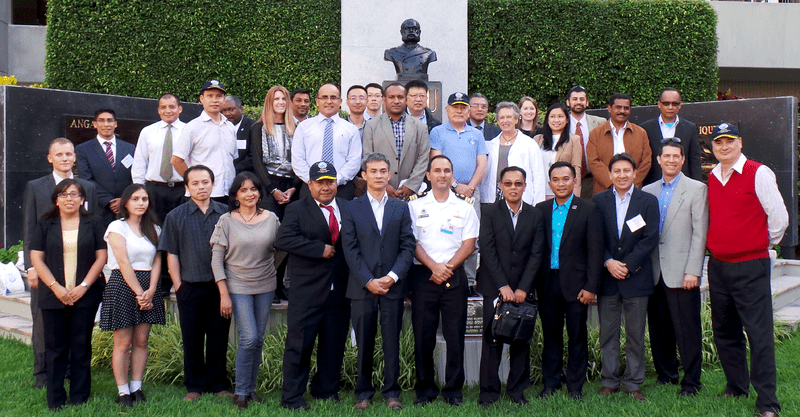
Emergency managers, transportation specialists, and business representatives from the Asia-Pacific Economic Cooperation (APEC) recently gathered for a workshop to improve the resilience of supply chains through modeling hazards and mapping risks. The event, “Improving Resilience of Global Supply Chains,” was held in Lima, Peru, May 4–6.
The event, organized by the USAID-US-APEC Technical Assistance to Advance Regional Integration (ATAARI) project in cooperation with the US Department of Transportation and Peru’s national disaster management organization, INDECI, drew participants from NDMOs, Ministries of Transportation, and other organizations from 19 of the 21 APEC economies. Welcoming remarks were provided by Gen. Alfredo Enrique Murgueytio Espinoza, Head of INDECI, and Minister Raul Salazar Cosio, Ministry of Foreign Affairs.
PDC’s DisasterAWARE was used to examine risk and vulnerability of supply chain components, such as manufacturing facilities, supporting vendors, and transportation nodes and routes. During breakout sessions, Pacific Disaster Center (PDC) Deputy Executive Director Chris Chiesa and PDC Liaison to the U.S. Southern Command Darron Pustam helped participants explore specific hazards and potentially vulnerable infrastructure within their economies.
Action Plans were drafted by participating economies. This included the identification of preliminary objectives, tasks, timelines, and responsible parties. DisasterAWARE was referenced in a number of these plans. It is expected that PDC will provide assistance as the economies begin implementation of their action plans.
For more information:
• Read an article about an Interactive APEC Workshop on Geospatial Information,
• An APEC feature on disaster readiness, or
• Visit the APEC EPWG website,
ABOUT PDC
Pacific Disaster Center (PDC) is a leading scientific innovator of global risk reduction science and technology. As a University of Hawai’i applied science and research center, our work intersects with a variety of government, community, academic, and scientific organizations at home and around the world to build resilience to natural and man-made hazards—enhancing the capacity to quickly and accurately anticipate and prepare for new and emerging threats. Our innovations in multi-hazard early warning systems, predictive analytics, data science, and machine learning provide decision-makers with the powerful tools and insights they need to navigate today’s complex and interconnected risk landscape.