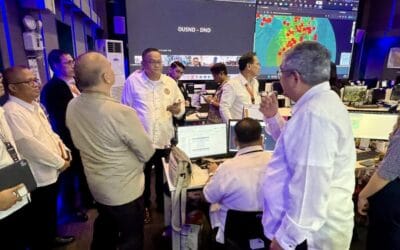
The Lao People’s Democratic Republic (PDR) Ministry of Science and Technology (MOST) invited the United Nations platform for Space-based Information for Disaster Management and Emergency Response (UN-SPIDER) to conduct an in-country Technical Advisory Mission (TAM). The mission was carried out July 6 through 10. Lao PDR requested the TAM to assist with building capacity for utilizing space-based information and services that are relevant to disaster managers, and to improve access to that information.
Pacific Disaster Center (PDC) joined the nine-person mission team which also included experts from UN-SPIDER, UN Office for Coordination of Humanitarian Affairs (OCHA), Asian Disaster Preparedness Centre (ADPC), National Disaster Reduction Centre of China (NDRCC), International Water Management Institute (IWMI), University of Georgia (UGA), and Delta State University (DSU). The team conducted discussions with eight Lao Government Ministries, key disaster management stakeholders, and the interim UN Resident Coordinator for the country, as well as senior staff from various UN agencies.
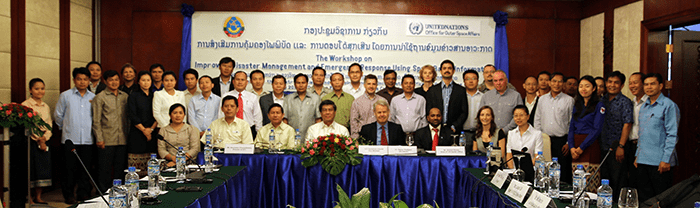
In order to prepare meaningful recommendations at the conclusion of the TAM, a one-day workshop on “Improving Disaster Management and Emergency Response Using Space-based Information” was organized for senior policy makers, data providers, disaster management agencies, and end users. The event included a technical session to help participants share their experiences and to encourage discussion. This session covered communication with stakeholders and action plans to implement recommendations, disaster risk reduction and emergency response, spatial data and high interoperability, awareness of technology trends, best practices, and specific needs in Lao PDR.
Following opening remarks from the Director General of the Department of Technology and Innovation Mr. Soumana Chounlamany, MOST Vice Minister Mr. Houmphanh Intharath, Head of UN SPIDER mission Mr. Shirish Ravan, and interim UN Resident Coordinator Dr. Stephen Rudgard, PDC Southeast Asia Program Advisor Victoria Leat delivered a presentation on the Center’s DisasterAWARE early warning and decision support platform and its use in Southeast Asia. The workshop closed with remarks from the Ravan and Chounlamany.
To conclude the mission, the team provided a briefing for MOST Vice Minister Mr. Houmphanh Intharath and senior staff, outlining recommendations for the use of space-based information for disaster management by Lao PDR experts. The recommendations will be expanded upon in the final TAM report, which will be submitted to the Government within two months. UN-SPIDER, along with its partners, will then engage with the Government of the Lao PDR and others to help facilitate implementation of the recommendations.
For more information:
- Check out the UN-SPIDER Knowledge Portal article,
- Read about other TAM participation in Vietnam, or
- International Charter.
ABOUT PDC
Pacific Disaster Center (PDC) is a leading scientific innovator of global risk reduction science and technology. As a University of Hawai’i applied science and research center, our work intersects with a variety of government, community, academic, and scientific organizations at home and around the world to build resilience to natural and man-made hazards—enhancing the capacity to quickly and accurately anticipate and prepare for new and emerging threats. Our innovations in multi-hazard early warning systems, predictive analytics, data science, and machine learning provide decision-makers with the powerful tools and insights they need to navigate today’s complex and interconnected risk landscape.