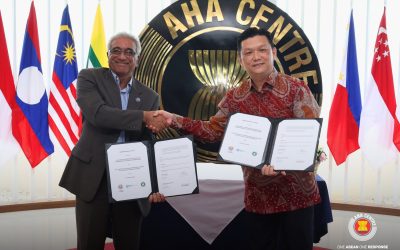
AHA Centre and PDC reaffirm their shared dedication to disaster risk reduction
Recent collaboration between ASEAN and PDC includes the newly released assessment titled...

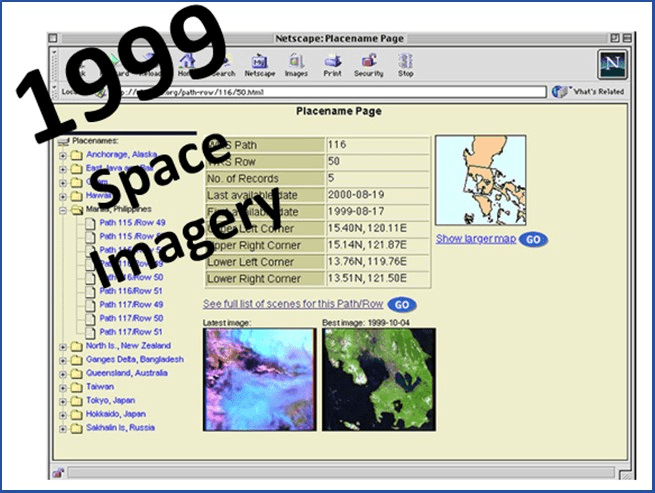
Years before Pacific Disaster Center (PDC) opened its doors in 1996, a definite cause and a clear vision of what such a Center was to do had to be established.
Back then, 1993–1996, the people involved in developing the initial concept of PDC had a vision of a center that would apply existing and rapidly emerging technologies to save lives by supporting the work of humanitarian assistance and disaster relief organizations. There were Senators, led by the late Daniel K. Inouye, thinking about it and inspiring related conversations at the U.S. Geological Service and the National Reconnaissance Office in Washington, DC. There were officers in the Hawaii State Department of Defense trying to pin it down. There was even a small group of people working at Hawaii State Civil Defense for whom answering “how to be PDC” was their main task.
Then, using language developed for a Department of Defense budget review process, Public Law 105-174—i.e., the 174th bill introduced in the 105th U.S. Congress—made the essential statement. The bill, which passed on May 1, 1998, included a paragraph stating:
“Sec. 12. Funds appropriated in fiscal year 1997, 1998 and hereafter for the Pacific Disaster Center may be obligated to carry out such missions as the Secretary of Defense may specify for disaster information management supporting mitigation, preparedness, response and recovery from this Federal facility and assuring critical infrastructure availability and humanitarian assistance at the Federal, State, local and regional levels in the geographic area of responsibility of the Commander in Chief, Pacific and beyond in support of the Global Disaster Information Network as appropriate. (including transfer of funds)”
In simpler language, by the passage of Public Law 105-174, PDC was given life and a mission statement. The Center would serve disaster managers in Hawaii, of course, but also all related U.S. interests in the “Pacific and beyond.” Nearly 20 years later, PDC services have expanded far beyond the original vision. Along with the meteorological and geological hazards, PDC activities and products now cover biomedical concerns, wildfire, human-induced hazards, and much more; the geographic extent of PDC data and activity is now global, giving a surprising definition to the phrase “Pacific and beyond.”
Over the past 20 years, PDC staff have worked with disaster management colleagues in more than 60 countries. PDC’s integrated decision support system—now called DisasterAWARE—is used around the world: tens of thousands rely the public Global Hazards Atlas, and well over 8,000 civil and military professionals turn to limited-access versions; and custom versions have been developed and deployed on behalf of 10 countries with others in development now. However, the largest audience for PDC disaster information products is made up of iOS and Android mobile device users: over 1.63 million of them have downloaded Disaster Alert to have hazard awareness at their fingertips wherever they go.
You may also want to look at:
ABOUT PDC
Pacific Disaster Center (PDC Global) is a leading scientific innovator in disaster risk reduction science and technology. As a University of Hawai’i applied science and research center, our work intersects with government, community, academic, and scientific organizations at home and around the world to build resilience to natural and man-made hazards. We enable communities to confront disasters more effectively by enhancing the capacity to rapidly anticipate and prepare for new and emerging threats using our AI-powered multi-hazard early warning technology, DisasterAWARE, predictive analytics, data science, and machine learning. For more than 30 years, PDC innovations have equipped decision-makers with the powerful tools and insights they need to navigate today’s complex and interconnected risk landscape.
PDC received prestigious recognition from the United Nations for its international impact in 2022, being granted the once-in-a-lifetime U.N. Sasakawa Award for Disaster Risk Reduction.
May 13, 2024 | Partnerships
Recent collaboration between ASEAN and PDC includes the newly released assessment titled...
May 3, 2024 | Advanced Analytics, Early Warning, Partnerships
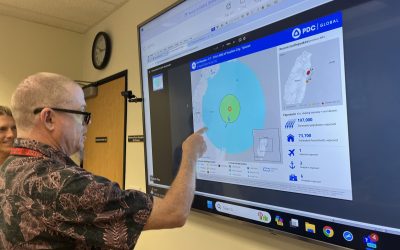
Geneva, Switzerland—During the week of May 6-10, 2024, participants at the U.N. Humanitarian Networks and Partnerships Weeks (HNPW) forum in Geneva, Switzerland will get a firsthand look at how PDC is spearheading transformative efforts within the “Early Warnings for All” initiative, including its advanced analytics
May 2, 2024 | Advanced Analytics, Partnerships
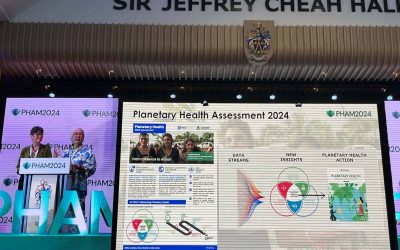
Kuala Lumpur, Malaysia—During the recent 2024 Planetary Health Summit and 6th Annual Meeting which took place from April 15-19 in Kuala Lumpur, Malaysia, the University of Hawai’i’s Pacific Disaster Center, and Sunway University formalized their partnership through the signing of a Memorandum of Understanding (MOU). The first collaborative activity planned under the new MOU is a Planetary Health Assessment to create a baseline understanding of the impacts of the planetary health crisis including extreme natural hazards, biodiversity loss, and pollution on the human and earth systems at the national level.

Mar 13, 2024 | Partnerships
Sixteen fellows of the 2024 Ka Ipu Kukui cohort recently came together to address the challenge of...
Apr 25, 2023 | National Disaster Preparedness Baseline Assessment, Partnerships
Pacific Disaster Center (PDC) and iMMAP Inc. recently announced a newly signed Memorandum of...

Dec 22, 2022 | Advanced Analytics, Early Warning, Partnerships, Press Kit
Floods are among the most deadly and costly types of disasters worldwide and are only increasing...