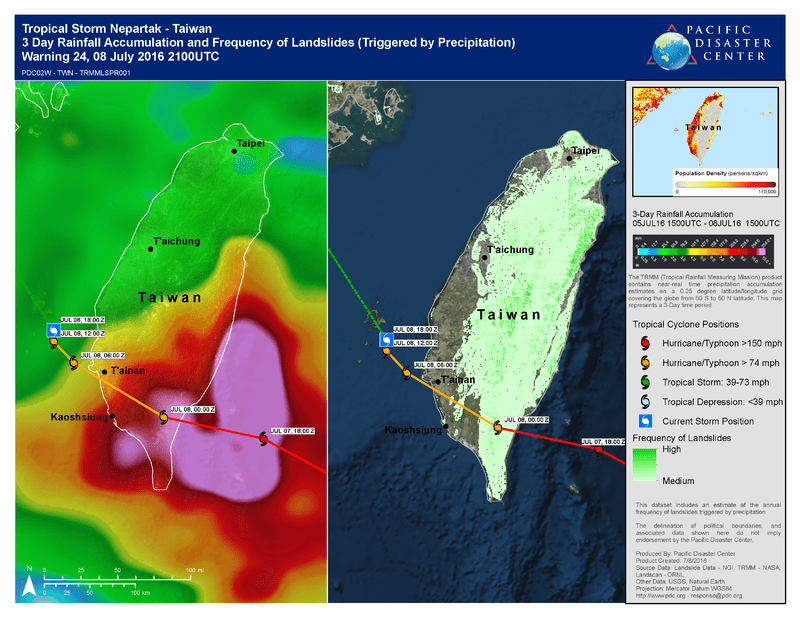
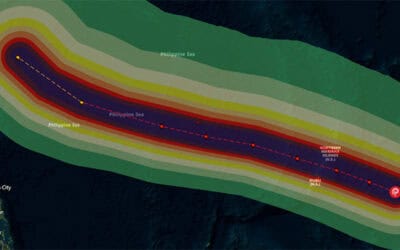
Since forming early this week, Tropical Cyclone Nepartak rapidly strengthened from a tropical storm to a Super Typhoon as it tracked across the western Pacific toward Taiwan. In the early hours of July 8 (local time), Typhoon Nepartak made landfall in the city of Taitung, with wind speeds of 120 miles (258 kilometers) per hour and torrential rain that impacted the island’s eastern, central, and southern regions.
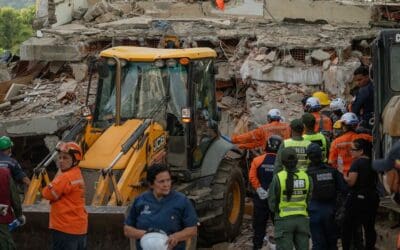
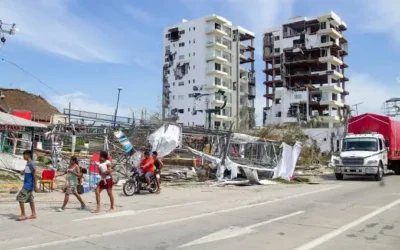
More than 15,000 people in flood- and landslide-prone areas of Taiwan were evacuated ahead of Typhoon Nepartak’s arrival. According to reports, Nepartak disrupted power supplies—cutting off power to over 517,000 households—and affected transportation. As of July 8, recovery operations are underway, with the restoration of utilities as a major concern.
As of the most recent advisory from the Joint Typhoon Warning Center, Nepartak is located approximately 142 nautical miles southwest of Taipei and has weakened to a tropical storm, with sustained winds near 69 miles per hour (60 knots). Nepartak is forecast to make landfall in eastern China’s Fujian province by Saturday, dissipating as it moves inland.
The heavy rainfall associated with Nepartak is expected to worsen the widespread flooding affecting central and southern China. Since the end of June, flooding and landslides triggered by heavy rainfall have led to the collapse of 56,000 houses, destroyed more than 560,000 hectares of crops, and forced the evacuation of more than 1.84 million people across the region.
Pacific Disaster Center is closely monitoring Tropical Cyclone Nepartak as impacts Taiwan and eastern China, and will continue to provide decision support and situational awareness products via EMOPS, PDC’s Emergency Operations system powered by DisasterAWARE. If you are an emergency manager or humanitarian assistance practitioner and would like access to EMOPs, click here for more information.
ABOUT PDC
Pacific Disaster Center (PDC Global) is a leading scientific innovator in disaster risk reduction science and technology. As a University of Hawai’i applied science and research center, our work intersects with government, community, academic, and scientific organizations at home and around the world to build resilience to natural and man-made hazards. We enable communities to confront disasters more effectively by enhancing the capacity to rapidly anticipate and prepare for new and emerging threats using our AI-powered multi-hazard early warning technology, DisasterAWARE, predictive analytics, data science, and machine learning. For more than 30 years, PDC innovations have equipped decision-makers with the powerful tools and insights they need to navigate today’s complex and interconnected risk landscape.
PDC received prestigious recognition from the United Nations for its international impact in 2022, being granted the once-in-a-lifetime U.N. Sasakawa Award for Disaster Risk Reduction.