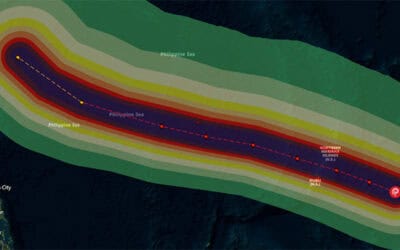
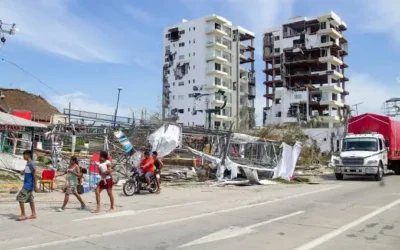
Late Wednesday night (local time), Typhoon Haima made landfall in the municipality of Peñablanca in the Cagayan Province of the Philippines, bringing winds up to 140 miles per hour (225 kilometers per hour) near its center, with gusts up to 195 miles per hour (315 kph). Known locally as Lawin, the typhoon was the second to hit the northern Philippines in a week, following behind Typhoon Sarika which made landfall in the Aurora Province of eastern Luzon on October 15.
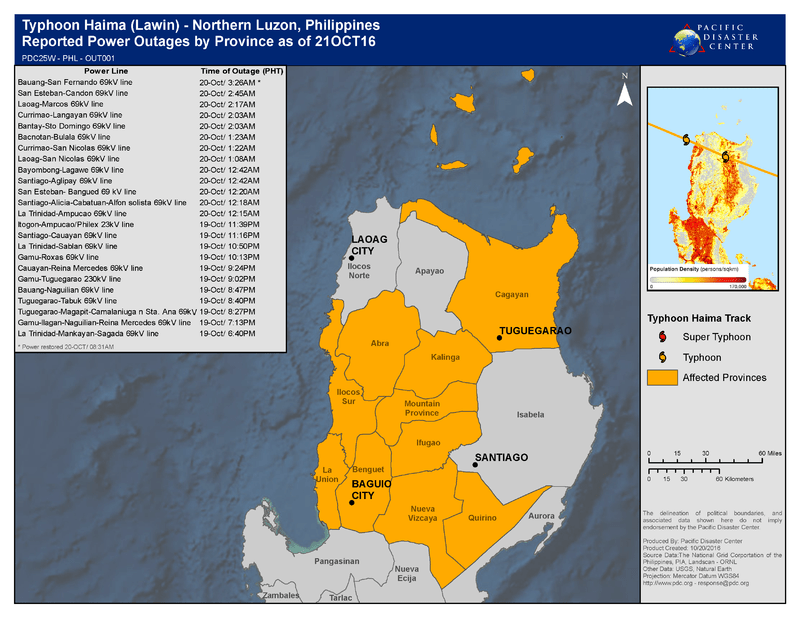
The Philippines National Disaster Risk Reduction and Management Council (NDRRMC) Response Pillar reports that, as of October 20 (0600 local time), more than 61,000 people in the Ilocos, Cagayan Valley, Central Luzon, Bicol, and Cordillera Administrative regions have been affected by Typhoon Haima, with more than 15,000 displaced. In addition to damaging houses, heavy rains and gusty winds associated with Haima toppled trees and electric posts, causing road blocks and widespread power outages.
With response operations underway in the Philippines, Pacific Disaster Center, a program managed by the University of Hawai‘i, continues to provide decision support and situational awareness products for Typhoon Haima. If you are an emergency manager or humanitarian assistance practitioner and would like access to PDC’s Emergency Operations (EMOPS) platform, powered by DisasterAWARE, click here for more information.
ABOUT PDC
Pacific Disaster Center (PDC Global) is a leading scientific innovator in disaster risk reduction science and technology. As a University of Hawai’i applied science and research center, our work intersects with government, community, academic, and scientific organizations at home and around the world to build resilience to natural and man-made hazards. We enable communities to confront disasters more effectively by enhancing the capacity to rapidly anticipate and prepare for new and emerging threats using our AI-powered multi-hazard early warning technology, DisasterAWARE, predictive analytics, data science, and machine learning. For more than 30 years, PDC innovations have equipped decision-makers with the powerful tools and insights they need to navigate today’s complex and interconnected risk landscape.
PDC received prestigious recognition from the United Nations for its international impact in 2022, being granted the once-in-a-lifetime U.N. Sasakawa Award for Disaster Risk Reduction.