In order to advance disaster management and disaster risk reduction across the region, the Association of Southeast Asian Nations (ASEAN) is engaged in a project to develop a set of regional risk and vulnerability assessment (RVA) guidelines. The guidelines will support a common approach to developing, analyzing, and sharing risk information that would inform decision making within the 10 ASEAN Member States (AMS) and the ASEAN Coordinating Centre for Humanitarian Assistance on Disaster Management (AHA Centre). Regional risk assessment is one of the strategic priorities of Phase II of the ASEAN Agreement on Disaster Management and Emergency Response (AADMER) Work Program.
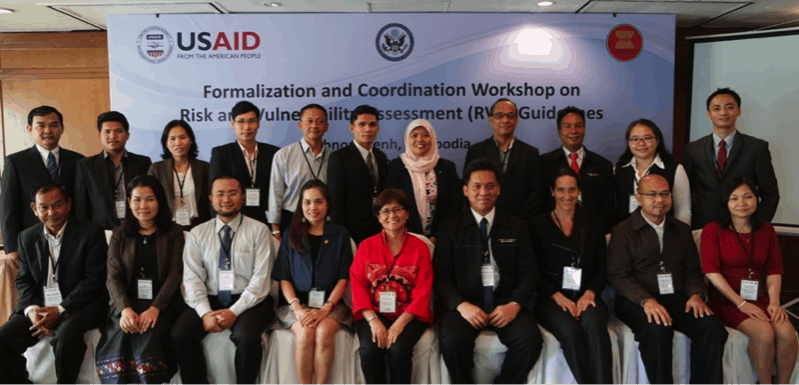
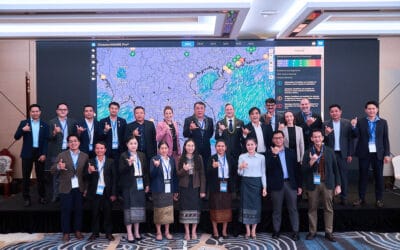
As part of the process to develop the guidelines, the ASEAN-U.S. Partnership for Good Governance, Equitable and Sustainable Development and Security (ASEAN-U.S. PROGRESS) conducted the “Formalization and Coordination Workshop on Risk and Vulnerability Assessment (RVA) Guidelines,” April 1 and 2, in Phnom Penh, Cambodia. Funded by the U.S. Agency for International Development (USAID), and co-organized by the Pacific Disaster Center (PDC), this event served as an opportunity to build consensus on the purpose of the RVA Guidelines, as well as the goals and basic implementation strategies. It was also an opportunity to present initial findings of a gap analysis and to gather additional information.
Representatives from seven AMS, the ASEAN Partnership Group, AHA Centre, ASEAN Secretariat, and Development Alternatives Inc. (DAI, the implementation partner for PROGRESS) participated in the workshop. Presentations, guided discussions, and surveys helped to explore common interests, capabilities, and challenges within the context of a regional RVA. Participants discussed issues related to data, methods and tools, application of the data, and institutional mechanisms, including such topics as data sharing and security, technical capacity, and sustainability.
With PDC co-organizing the event and providing technical support to ASEAN, PDC Director of Applied Science Dr. Heather Bell facilitated the workshop. Bell is also managing the process for the development of RVA guidelines.
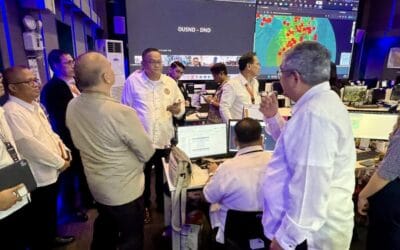
In the future, once agreements are in place and the guidelines have been implemented in the AMS, the vision is to integrate relevant information into the DisasterAWARE-based Disaster Monitoring and Response System (DMRS) at the AHA Centre. PDC is supporting another Phase II project to enhance the utility and data content of DMRS. A third, related project currently underway with PROGRESS support will result in the development of curricula for three disaster management courses.
For more information on this event:
• View the AHA Centre website to learn about the AADMER Work Program,
• Visit the ASEAN Facebook page for more images, and
• Read more about the ASEAN-U.S. PROGRESS here.
ABOUT PDC
Pacific Disaster Center (PDC Global) is a leading scientific innovator in disaster risk reduction science and technology. As a University of Hawai’i applied science and research center, our work intersects with government, community, academic, and scientific organizations at home and around the world to build resilience to natural and man-made hazards. We enable communities to confront disasters more effectively by enhancing the capacity to rapidly anticipate and prepare for new and emerging threats using our AI-powered multi-hazard early warning technology, DisasterAWARE, predictive analytics, data science, and machine learning. For more than 30 years, PDC innovations have equipped decision-makers with the powerful tools and insights they need to navigate today’s complex and interconnected risk landscape.
PDC received prestigious recognition from the United Nations for its international impact in 2022, being granted the once-in-a-lifetime U.N. Sasakawa Award for Disaster Risk Reduction.