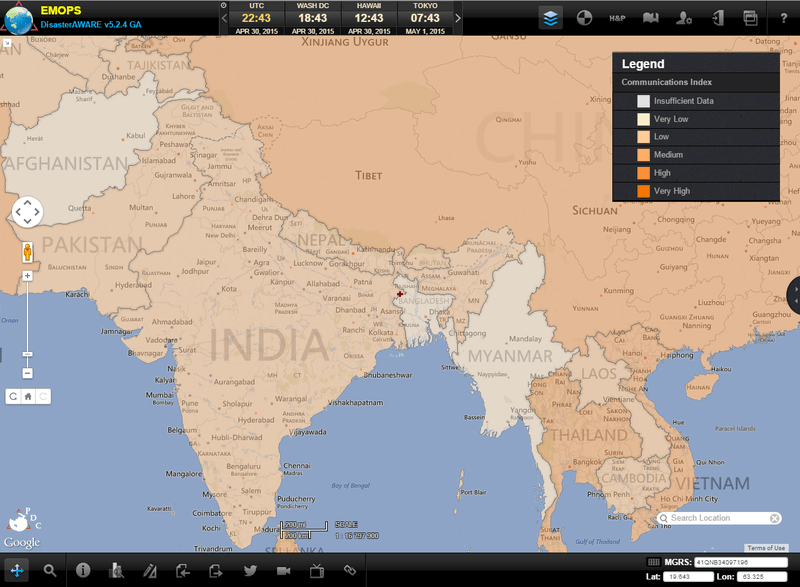
Recent bolstering of emergency communications capabilities in Nepal has improved the connectivity and coordination of the Off-Site Operation Coordination Centre (OSOCC) with international search and rescue teams out in the field. Internet connectivity at the Ministry of Health and Population has also been enhanced through the installation of portable satellite terminals. Communication has been a concern since response operations began in Nepal, but reports indicate that the communications system has become more stable, though challenges still exist.
Coordination in the field is important as response operations broaden into the more remote mountain regions, closer to the epicenter, where extensive damage is anticipated.
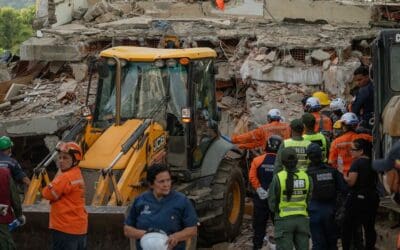
Reports from Nepal’s government indicate that more than 130,000 houses were destroyed, and over 85,000 were partially damaged by the earthquake. As more assessments on village-level damage become available, early recovery support to Village Development Committees (VDCs)—Nepal’s village-level government—has been made available to address immediate needs within communities.
Learn more:
• Find PDC products about the 7.8M earthquake,
• Read about a 2014 Disaster Response Exercise in Nepal, or
• Visit ReliefWeb for additional sources and links.
Additional PDC news regarding the 7.8M earthquake in Nepal:
• Relief to Severely Impacted Remote Villages Hampered by Inaccessibility, Adverse Weather Conditions
• Preparedness Efforts Help Support Response in Nepal
• Initial Damage and Needs Assessment in Nepal
• Food Security Concerns in Nepal Grow as Demands Exceed In-Country Supply
• Health Care Resources Stretched Beyond Capacity by Earthquake Injuries
• Data Access for Supporting Response and Recovery in Nepal
• Critical Data on Infrastructure in Nepal as Death Toll Rises
• 7.8M Earthquake Strikes Nepal, Followed by Aftershocks
ABOUT PDC
Pacific Disaster Center (PDC Global) is a leading scientific innovator in disaster risk reduction science and technology. As a University of Hawai’i applied science and research center, our work intersects with government, community, academic, and scientific organizations at home and around the world to build resilience to natural and man-made hazards. We enable communities to confront disasters more effectively by enhancing the capacity to rapidly anticipate and prepare for new and emerging threats using our AI-powered multi-hazard early warning technology, DisasterAWARE, predictive analytics, data science, and machine learning. For more than 30 years, PDC innovations have equipped decision-makers with the powerful tools and insights they need to navigate today’s complex and interconnected risk landscape.
PDC received prestigious recognition from the United Nations for its international impact in 2022, being granted the once-in-a-lifetime U.N. Sasakawa Award for Disaster Risk Reduction.